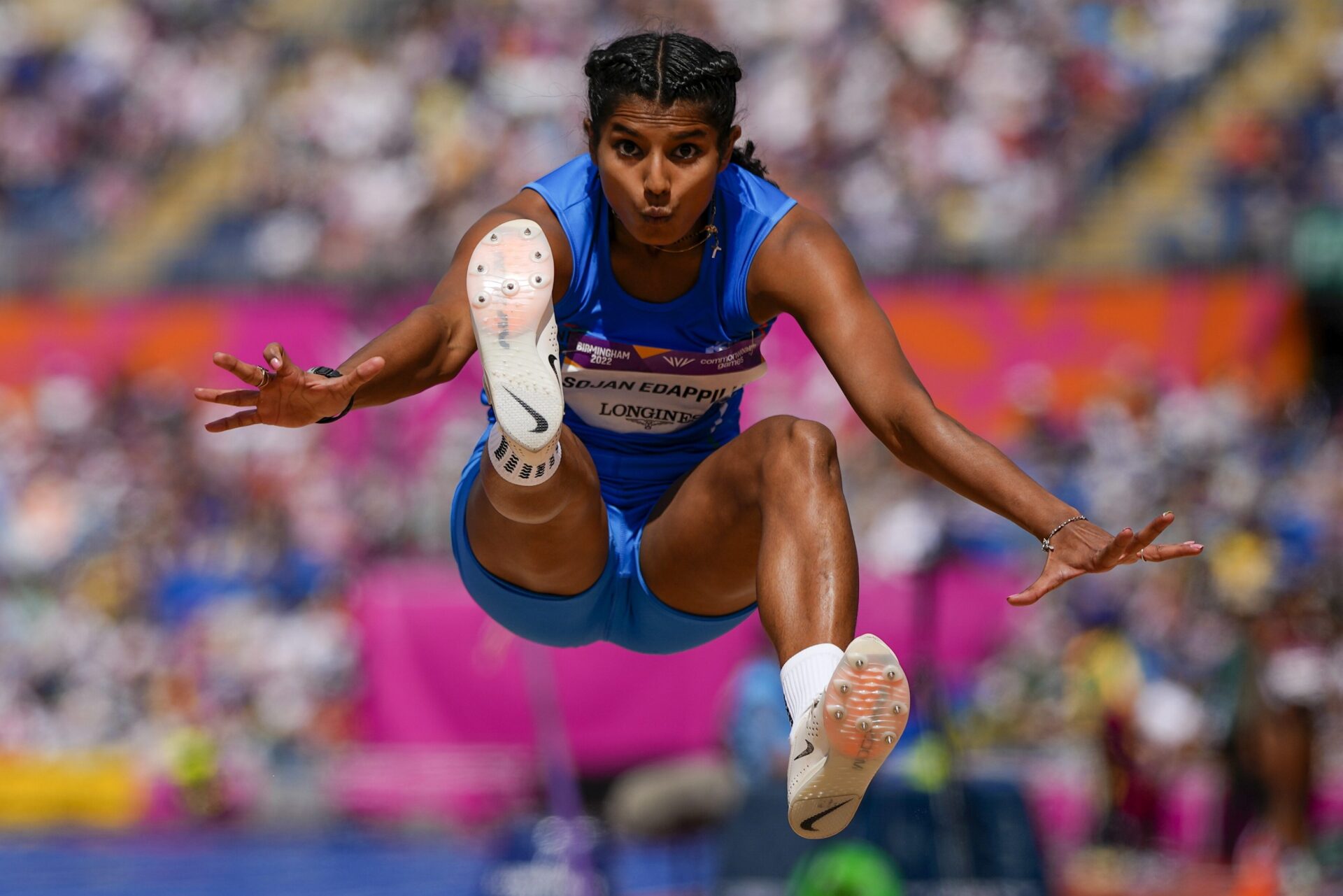
After breaking the long-standing national record in women’s long jump, Ancy Sojan spoke about consistency and how she and her team should be focusing on zoning in and around the 6.70 metres mark. The girl from Kerala’s Thrissur district had just gone past Anju Bobby George’s 22-year-old national record of 6.83m, set at the 2004 Athens Olympics, by clearing 6.88m at the National inter-state senior athletics championships in Bhubaneswar recently.
Ancy Sojan has broken Anju Bobby George’s 22-year-old record of 6.83m by clearing 6.88m. AP/PTI
At the same meet, Sarvesh Kushare put Tejaswin Shankar’s record of 2.29m to shade after he jumped 2.31m. He became the first Indian to cross the 2.30m mark in high jump. Ancy Sojan and Kushare’s feats are part of a growing number of athletes who have rewritten the Indian record books this year alone.
A total of 26 national marks have been bettered over the course of a few months, none bigger than Gurindervir Singh’s iconic 100m finish at the Federation Cup in Ranchi by clocking 10.09 seconds. Animesh Kujur registered the record that stood previously, 10.15s, only a day earlier in the heats.
Gurindervir’s celebration where he tore away his bib number before the finish line and his statement — “Indian gene tagde hai” — were splashed all over social media.
So, has the Indian track and field turned over a new leaf and is it ready to challenge the world? If one looks at only the records, there is a positive vibe. Srabani Nanda, Sneha Shanuvalli, Sudeshna Shivankar and Tamanna clocked the season’s best time of 43.85 seconds to win the women’s 4x100m relay final to beat China at the Asian Relays Championships in China.
The Indian 4x100m quartet after winning gold at the Asian Relays meet in China.
It was magical to see four Indian girls, from varied backgrounds, go toe-to-toe with China, and beat them to the finish line. But are they ready to take on the world? Surely not. A simple look at the World Athletics Top Lists, which shows the season’s best timings in team and individual disciplines, and our Indian quartet are ranked 62nd in the world.
It shows a grim reality that Indian track and field has a long way to go to be taken as a serious global contender.
As per the Inspire Institute of Sport (IIS) sprints coach Saharsh Shah, hard work is the only way forward. “Getting close to 11 seconds is relatively easy. Any sprinter with a few technical corrections and basic technique can get there. However, to get closer to the 10 seconds mark, not everything is about training alone. It has to do more with the mindset of the athlete, his recovery sessions, using high-performance programmes and biomechanical testing to reach there,” Shah said.
“Let’s use a toothpaste tube as an example. When the tube is new, it is easier to squeeze out the paste. As it nears the finish, one has to squeeze harder and harder. It is the same in sprints. Having said that, all these results create momentum and everyone one who is involved is forced to work harder to get better and better,” he added.
It is not all doom and gloom as both Sarvesh Kushare in high jump and Rohit Yadav in javelin are among the leading athletes in the world. Kushare’s record of 2.31 metres makes him joint third in the ranking with Great Britain’s Kimani Jack. Yadav’s gold-winning attempt of 87.05 metres makes him second on the list after Sri Lanka’s Romesh Pathirage’s monstrous throw of 92.62m this season.
Sarvesh Kushare is the first Indian to cross the 2.30m mark in high jump. Reuters
The Athletics Federation of India (AFI), although cautious, states its decentralised training system is starting to show results. Previously, the track and field stars were being trained in national camps. Now, all these stars are free to train with their coaches at centres run by the Reliance Foundation, and JSW, while the jumpers are training at the Anju Bobby George Academy in Bengaluru.
“The decentralised programme is clearly working. All these results make us happy and are a good build-up towards a healthy bench strength. Sarvesh, Gulveer, Vishal TK have been performing consistently,” AFI former president and chairman of the selection committee Adille Sumariwalla said, talking about the host of records being broken.
“Not for a second am I saying that suddenly we are world class, but 20-odd records have been broken and this is a good indicator, but we still have a long way to go. When I saw 15 runners go under the Asian Games qualifying standard (1.48.80s) in 800m, I was shaken. We were used to seeing one runner way ahead. Now you do not know who is winning from the line-up. This is real progress,” he added.
Gulveer Singh (R) with his training partner and mentor Kartik Kumar. Gulveer Singh is the reigning national record holder in both men’s 5000m and 10000m. PTI
The doping taint
Despite the positive vibes, Indian athletics is also topping the charts for the wrong reasons. India tops the Athletics Integrity Unit’s (AIU) global list of doping. Kenya is second with 148 offenders, followed by Russia with over 60 names on the list.
One reigning 1500m national record holder, KM Deeksha, who ran 4:04.78 seconds to register the mark last year, is facing a four-year suspension after out-of-competition testing showed the presence of anabolic steroids in her sample.
Sports watchers are quick to point out that both the World Anti-Doping Agency (WADA) and AIU are keeping a special watch on Indian elite athletes.
AIU has already put India on the list of extremely risky countries where the number of doping cases is consistently higher. The developments put a serious question mark on India’s push to become a global sports superpower.
Season’s best
— Sarvesh Kushare is ranked joint third in rankings alongside Great Britain jumper Kimani Jack in the World Athletics Top Lists chart for 2026, as both cleared the mark of 2.31m in high jump.
— Ancy Sojan is ranked 7th after her national record of 6.88m in long jump this season. USA’s Tara Davis-Woodhall leads the list with a leap of 7.21m.
— Gurindervir Singh (10.09s) is ranked 87th. The chart is led by Jamaica’s Oblique Seville. He has clocked 9.82s this season.
— Animesh Kujur’s timing of 20.32s (200m) would put him 73rd in rankings. Cayman Islands’ Jayden Reid has clocked 19.63s.
— Vishal TK (national record of 44.98s in 400m) is ranked 66th. Nigeria’s Samuel Ogazi, who clocked 43.38s, tops the list.
— Srabani Nanda, Sneha Shanuvalli, Sudeshna Shivankar and Tamanna clocked the season’s best time of 43.85 seconds to win the women’s 4x100m relay final of Asian Relays Championships. They are ranked 62 in the world. USA has posted the leading time of 41.58s.
— Gulveer Singh holds the national record in both 5000m (12:59.77) and 10000m (27:00.22). He would be ranked 21st and 11th, respectively.
— Tejas Shirse (13.27s in 110m hurdles) is 31st. USA’s Ja’Kobe Tharp clocked 12.75s.
